The Science Behind Rubric-Based Grading
Rubrics exist in most classrooms, but their full potential is rarely realized. Most teachers use rubrics primarily as grading tools — a structured way to ensure consistency across student work and justify the scores they assign. This is valuable, but it captures only a fraction of what rubrics can do. The cognitive science of learning provides strong evidence that rubrics, when shared with students before they begin work, function as powerful instructional tools that improve the quality of what students produce — not just the efficiency with which teachers grade it.
The mechanism is clarity of expectations. When students understand specifically what distinguishes excellent work from adequate work in each dimension they are being assessed on, they can self-monitor more effectively during the creation process. Studies comparing student performance on tasks with and without rubrics shared in advance consistently show higher quality work when students have the rubric before they start. The effect is strongest when the rubric is discussed — when students examine examples of work at different performance levels and practice evaluating them against the criteria — rather than simply distributed. That discussion builds the evaluative vocabulary students need to apply the rubric to their own work.
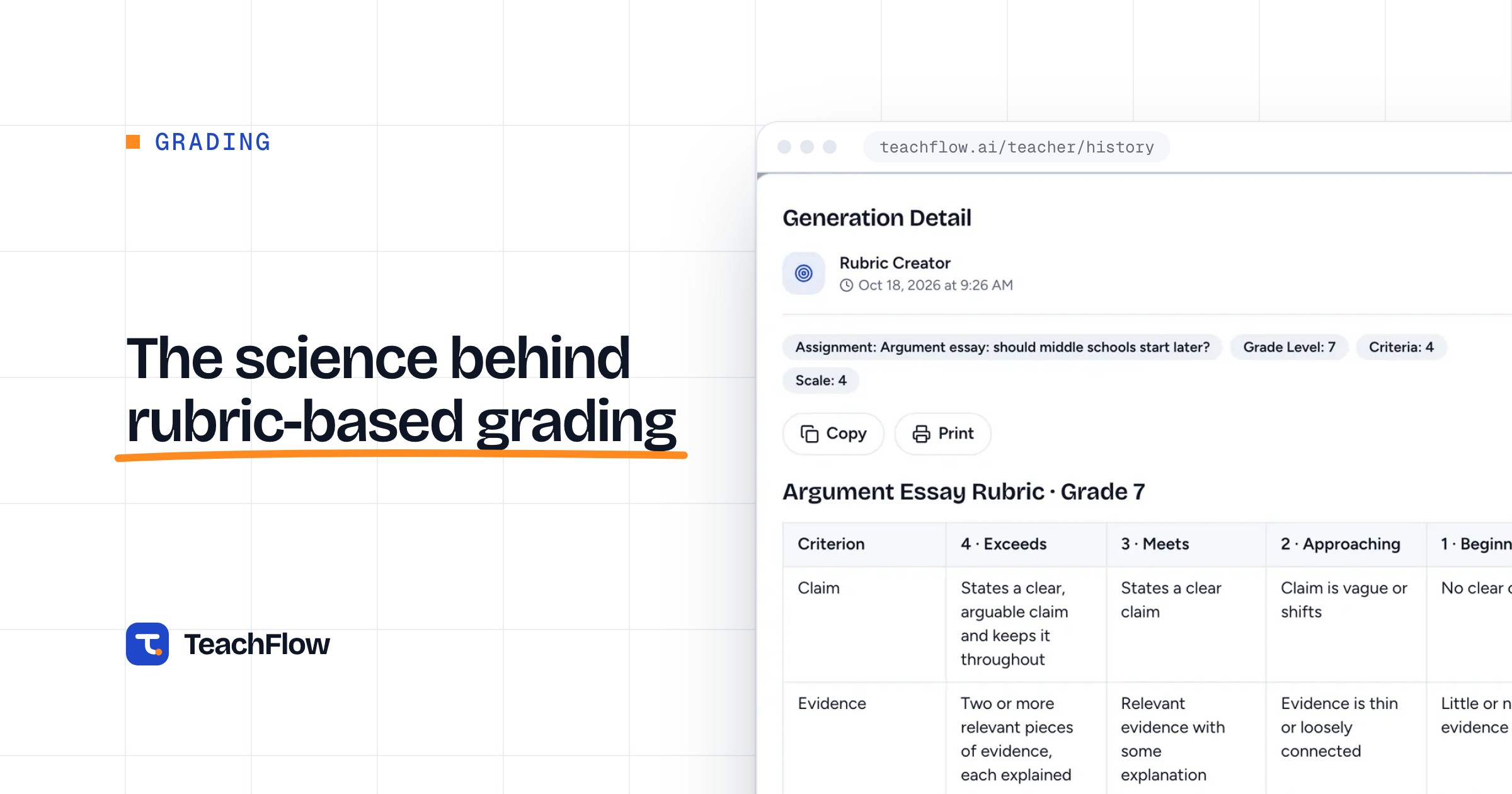
The design of the rubric matters substantially for both purposes. Rubrics that describe specific, observable qualities at each performance level are more useful than rubrics that use vague evaluative language. "Includes three or more specific pieces of evidence, each directly connected to the central claim" is more actionable than "strong use of evidence." Rubrics with too many dimensions can overwhelm students and create grading complexity that defeats the consistency purpose. For most assignments, three to five dimensions, each with four performance levels, is enough granularity to be useful without becoming unwieldy. Getting rubric design right is one of those investments that compounds: well-designed rubrics can be refined and reused across years rather than rebuilt from scratch each time.